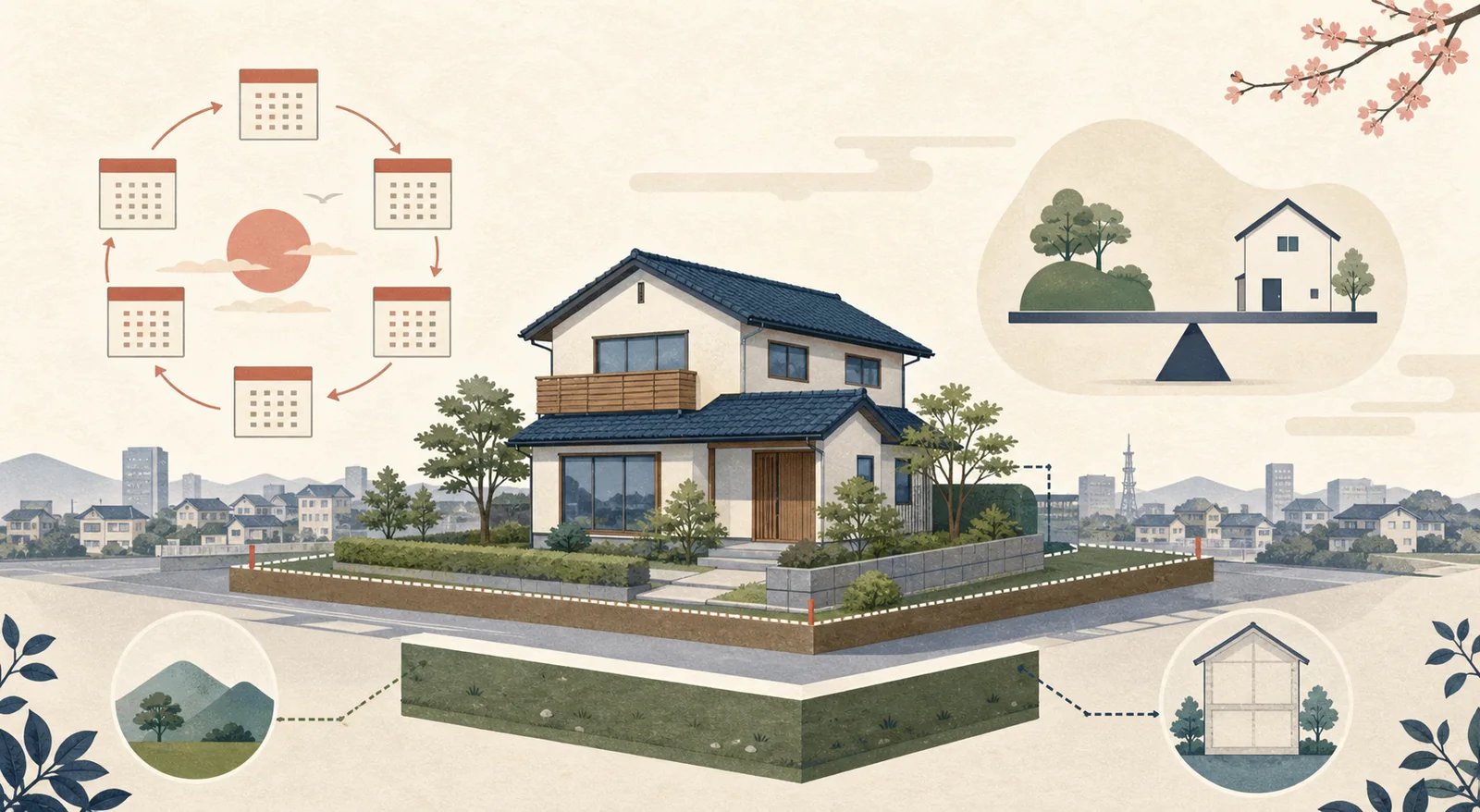
Japan property tax for foreign owners is generally calculated from the property and its official assessed value, not the owner's nationality. The main recurring charge is fixed-asset tax, with a standard rate of 1.4%. City-planning tax of up to 0.3% may also apply in designated urban areas. Both land and buildings are assessed separately, and residential-land reductions can make the taxable base much lower than a simple percentage of the purchase price.
Foreign ownership does not remove the obligation, and living overseas can make administration harder. Budget the purchase taxes separately, identify who will receive and pay municipal bills, and verify the assessed values before closing.
The taxes at a glance
| Tax | When it arises | Broad calculation basis | Government level |
|---|---|---|---|
Fixed-asset tax (kotei shisan zei) |
Every year | Official fixed-asset taxable value; standard rate 1.4% | Municipal |
City-planning tax (toshi keikaku zei) |
Every year in applicable planning areas | Official taxable value; rate capped at 0.3% | Municipal |
Real-estate acquisition tax (fudosan shutoku zei) |
After acquisition | Prefectural assessed value after applicable reductions | Prefectural |
| Registration and license tax | When registering ownership or a mortgage | Usually official assessed value, or secured amount for a mortgage | National |
| Stamp tax | On taxable paper contracts | Contract amount bands | National |
| Consumption tax | Potentially on the building/business components | Transaction and seller status; land transfer is not subject | National/local |
The Ministry of Land, Infrastructure, Transport and Tourism (MLIT) groups these by lifecycle: registration and acquisition taxes when buying, fixed-asset tax while owning, and income or corporation tax when selling, in its official land-tax overview.
Annual fixed-asset tax
The person recorded as owner on January 1 is generally the taxpayer for that fiscal year's fixed-asset tax. Municipalities assess land and buildings separately. MLIT's official possession-tax table lists a 1.4% standard rate on the fixed-assets tax assessed value.
The tax is not normally:
purchase price × 1.4%
Instead, it is closer to:
municipal taxable base for each asset × local rate
The official assessment can differ materially from the market price. Land and building values also move differently over time: buildings generally depreciate under the assessment system, while land depends on location and periodic valuation.
Residential-land reductions
For qualifying residential land, MLIT lists these special taxable-base measures:
- up to 200 m² per dwelling: one-sixth of the fixed-asset assessed value;
- the portion above that small-residential-land limit: one-third.
These are reductions to the tax base, not discounts from the purchase price or automatic reductions to every parcel. Use, dwelling count, site allocation, construction status, and local application can affect treatment. Vacant land without a qualifying residence may be taxed on a less favorable base, which matters when buying an akiya for demolition.
City-planning tax
City-planning tax may apply to land and buildings in designated urbanization areas. MLIT lists a 0.3% maximum rate and residential-land taxable-base measures of one-third for the small residential portion and two-thirds for general residential land.
Not every municipality imposes the maximum, and not every property falls within the relevant area. Ask the municipality or review the latest tax certificate rather than adding 0.3% automatically.
A worked annual-tax example
Assume a municipality uses:
- land fixed-asset value: ¥12,000,000;
- building fixed-asset value: ¥8,000,000;
- the entire land qualifies as small-scale residential land;
- fixed-asset tax rate: 1.4%; and
- city-planning tax rate: 0.3%.
An illustrative calculation is:
| Component | Fixed-asset tax | City-planning tax |
|---|---|---|
| Land | ¥12,000,000 × 1/6 × 1.4% = ¥28,000 | ¥12,000,000 × 1/3 × 0.3% = ¥12,000 |
| Building | ¥8,000,000 × 1.4% = ¥112,000 | ¥8,000,000 × 0.3% = ¥24,000 |
| Total | ¥140,000 | ¥36,000 |
Illustrative annual total: ¥176,000.
This is a teaching example, not a quote. Municipal rounding, relief for qualifying new housing, reconstruction, mixed use, condominium common-land shares, and other rules can change the bill.
Who pays in the purchase year?
Legally, the January 1 registered owner is the municipal taxpayer for that fiscal year. In a sale, the parties commonly adjust the economic burden at closing under the contract, using an agreed proration date and local convention. That settlement is a private allocation between buyer and seller; it does not rewrite the municipality's taxpayer record for that year.
Before signing, ask for:
- the latest fixed-asset valuation certificate;
- the latest tax notice and payment status;
- the proration formula and base date;
- separate land and building amounts;
- confirmation of residential-land treatment; and
- any arrears or enforcement issues.
Do not estimate from the listing price when the seller can provide actual records.
One-time real-estate acquisition tax
Real-estate acquisition tax is a prefectural tax that can arrive months after completion, when the excitement and closing budget have passed. Current MLIT guidance lists the main rate as 4%, with temporary measures through March 31, 2027 applying a 3% rate to land and residential buildings, a half-base measure for land, and residential deductions where conditions are met. MLIT summarizes these current measures in its land-acquisition tax table.
For qualifying homes, the result may be far below a raw 3% of market price. MLIT's residential acquisition-tax guidance describes a ¥12 million deduction from the taxable base for qualifying new housing and age-linked deductions for existing housing.
Eligibility is fact-specific. A second home, rental property, small unit, old structure, or non-compliant building may not receive the relief a buyer expected. Ask the prefectural tax office which application and evidence are required.
Registration, mortgage, and stamp taxes
Registration and license tax is paid when ownership or a mortgage is registered. The National Tax Agency's current home-acquisition tax guide lists, among other rates:
- land ownership transfer by sale: 1.5% through March 31, 2029;
- building ownership transfer: 2% generally, or 0.3% for a qualifying owner-occupied home through March 31, 2027;
- ownership preservation: 0.4% generally, or 0.15% for a qualifying home; and
- mortgage registration: 0.4% generally, or 0.1% under the qualifying-home measure.
The base is not necessarily the contract price. Ownership registration generally uses the fixed-asset value; mortgage registration uses the secured claim amount.
Taxable paper real-estate contracts also carry stamp tax. The same NTA guide shows the reduced schedule through March 31, 2027—for example, ¥10,000 on a contract above ¥10 million and up to ¥50 million. Confirm whether your executed document is paper or electronic and which instrument is taxable.
For a complete pre-closing budget, see closing costs when buying a house in Japan.
Consumption tax: separate land from building
Japan consumption tax does not apply to the transfer of land. The NTA's consumption-tax explanation identifies land purchases and leases as non-taxable, while transfers of buildings by a taxable business can be taxable.
This does not mean every used-home sale has consumption tax added. A private individual selling outside a business may be treated differently from a developer or taxable enterprise. The contract should allocate land, building, and tax where relevant; that allocation can also affect brokerage-fee calculations.
How an overseas owner should manage payment
A municipality sends notices to the registered address or designated destination under its procedure. Overseas mail, Japanese-only forms, and local payment methods create operational risk even when the amount is modest.
Before leaving Japan or completing as a non-resident:
- Ask the municipality whether it requires or accepts a tax manager or local contact.
- Confirm the mailing address recorded for tax notices.
- Arrange a domestic payment method or professional payment service.
- Calendar expected notice and installment periods.
- Require the local contact to send scans and proof of payment.
- Reconcile condominium fees and taxes separately; they are not the same charge.
Late payment can create penalties and enforcement problems. A property manager's normal rental remit does not automatically include municipal-tax administration.
Budgeting checklist before you buy
- Obtain actual tax and valuation certificates.
- Model annual fixed-asset and city-planning tax by land and building.
- Ask what happens to residential-land relief if the building is demolished.
- Get a written acquisition-tax estimate from a tax professional or prefectural office.
- Include registration tax for ownership and any mortgage.
- Confirm stamp tax and consumption-tax treatment.
- Keep a reserve for a post-closing acquisition-tax bill.
- Appoint a reliable local tax contact if you will live overseas.
- Review rental-income, withholding, and tax-representative duties if the property will be let.
The annual bill is one part of carrying cost. Insurance, repairs, management, utilities, condominium dues, and reserve-fund contributions belong in the same ownership model. Browse homes across Japan or use the Nipponhomes map explorer. When comparing markets, treat Yokohama properties and homes in Kyoto City as separate municipal diligence exercises, then replace listing-level estimates with local evidence.
Sources
- MLIT — outline of taxes at acquisition, ownership, and sale
- MLIT — fixed-asset and city-planning tax rates and residential-land measures
- MLIT — current land-acquisition tax measures
- National Tax Agency — taxes when acquiring a home
- National Tax Agency — consumption-tax basics
Important note
This article is general information, not tax or legal advice. Rates, relief periods, assessed values, municipal procedures, and eligibility change. Confirm the current bill and valuation with the municipality, acquisition tax with the prefecture, and national taxes with a qualified Japanese tax professional before relying on an estimate.