
So we’ve all seen the headline at this point... Nikkei, October 31st: “Tax on overseas residents’ Japanese rental businesses — Ministry considers it to ensure fairness” (Nikkei).
But let’s dive into what it actually means, what they’re trying to do here, and whether it’s going to affect you.
How you’re taxed right now: income tax, and that’s it
As an owner of a foreign real estate business in Japan... ryokan rentals, minpaku rentals, hotels, long-term rentals... you are subject to income tax in Japan. Japan taxes your rental income from a Japanese property whether you live there or not. You file once a year (the return covers the calendar year and is due March 15th), usually through a tax representative in Japan, and you pay on your net income.
It’s variable, but it’s quite cheap if you’re like most of our clients and have one 4-bedroom house in a ski town that grosses $30K USD a year. Because after all the expenses, cleaning, shoveling, utilities, property tax, our management fee, even your trips to Japan to take care of the house are legitimate write-offs, flights, car rentals, your tax burden ends up quite low.
Keep it honest though. The days you’re there skiing for yourself aren’t business, and the nights you block off for personal use don’t count either.
Here’s roughly what that looks like on a typical ski house. Your numbers will be different OF COURSE, this is just for reference:
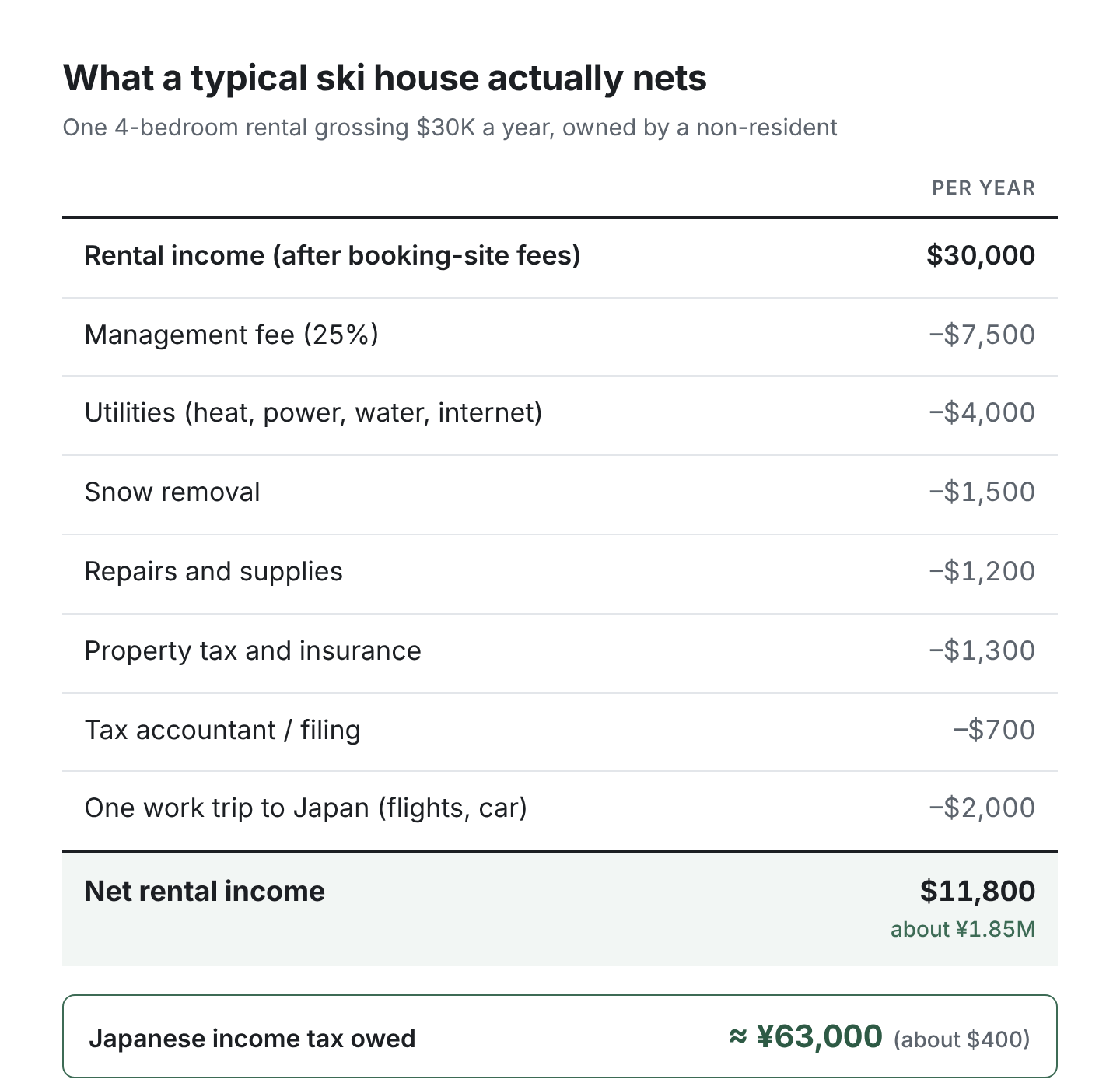
Cleaning isn’t on there because guests pay it through the cleaning fee, so it washes out.
Japan’s income tax starts at 5% on the first ¥1.95M of taxable income, plus a 2.1% reconstruction surtax on top. For 2026 income, non-residents get a basic deduction of up to ¥620,000 , up from ¥580,000 last year. So ¥1.85M minus ¥620K leaves about ¥1.23M taxable... times 5.1%... that’s about ¥63,000 a year. Roughly $400.
And that’s before depreciation. If you bought an older wooden house (more than 22 years old), Japan lets you write the building off over as little as 4 years. Say $40K of your purchase price was the building. That’s about $10K a year in write-offs for 4 years, and on this house it takes your Japanese income tax to zero.
That’s it. Income tax is the only tax you’re paying in Japan on your rental income. (You’ll still pay the yearly property tax on the house, but that’s just another line in the expenses above.)
Example uses ¥157 to the dollar, the rate as of November 2, 2026.
What about taxes back home?
Now of course you’ll also have to report that income in the US, or whatever home country you live in.
But Japan has a tax treaty with most of the countries our clients come from... Canada, the US, Australia, the UK, France, Mexico, Spain, Singapore... and Taiwan has its own agreement with Japan that works the same way.
I can’t speak for everyone of course, but your country is a quick Google search away.
Japan taxes income from Japanese property, and your home country gives you a credit for the tax you already paid in Japan. Generally that’s dollar for dollar, up to what you’d owe at home on that same income. So you don’t experience double taxation. How it works varies by country, so this is one for your accountant back home.
One thing to keep straight: the credit means you’re not paying twice, it doesn’t mean you’re paying nothing.
But in Japan , you’re only paying that one income tax.
The gap: a local doing the same thing pays more
But if you’re the same person doing the same thing living in Japan , once your rentals get big enough you’re also subject to a business tax. So you’re a local doing the exact same thing and you’re paying more taxes... that doesn’t make much sense to me.
Individual business tax is a prefectural tax: 5% on rental income above a ¥2.9M yearly deduction, charged by the prefecture where your office is.
A local landlord usually doesn’t have an office, so their home address counts as one. If you live overseas, you have neither. No office, no Japanese address... nothing for the prefecture to attach the tax to.
So right now you just don’t pay it.
And to be clear, this isn’t a foreigner thing. It’s about where you live. A Japanese salaryman transferred to Singapore who rents out his Tokyo apartments falls in the exact same gap.
So what this proposal is trying to do is close that gap so people living overseas aren’t getting a tax advantage. I fully support this. I think it’s a great idea. We shouldn’t be getting a benefit by not living in Japan full time.
It’s also part of a pattern. Japan already ended the consumption tax exemption on real estate brokerage fees for overseas residents, effective October 1st this year, with the same “fair burden” reasoning.
Will this even affect you? Probably not
Assume this does pass. Will it even affect you? Probably not. There are thresholds you have to hit before you’re subject to this business tax at all.
The thing to know is that the rule is set by the prefecture. So Sapporo, Otaru, Niseko and Asahikawa all follow Hokkaido’s rule, Hakuba and Iiyama follow Nagano’s, and Myoko follows Niigata’s. Here’s where we operate the most and what those rules look like:
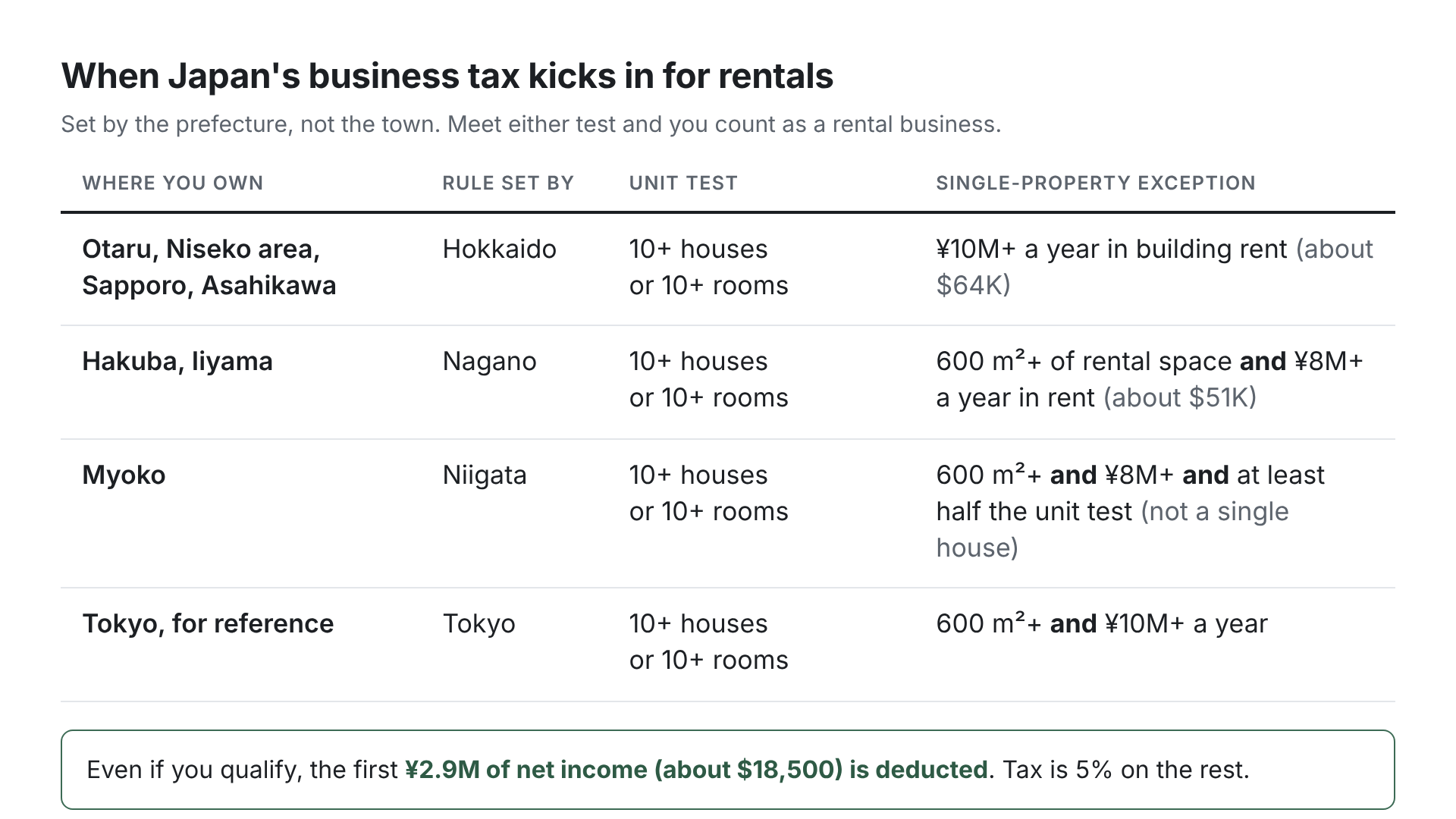
And notice the Hokkaido line. If you’ve got one big Niseko chalet doing more than ¥10M a year in rent, Hokkaido can treat that single building as a rental business. That’s the one group of our clients I’d tell to keep an eye on this.
One more interesting wrinkle for Airbnb owners because nothing with taxes can ever be straight forward. In Japanese tax terms, short-term rental income isn’t always “rental.” How your house gets classified decides which test applies, and there are three buckets:
Miscellaneous income. This is how the tax office often treats minpaku income. It’s not considered a business, so there’s no business tax at all.
Rental income. This is mostly long-term and monthly (30+ day) leases. The 10-unit test applies, so one house is out.
Lodging business. A licensed ryokan run as a business lands here, and a minpaku can too if it’s clearly run as a business. There’s no unit minimum, so even one small property automatically counts as a business thats subject to tax.
Most of our clients’ houses land in the third bucket. So the 10-unit test probably isn’t what protects you.
Right now none of this applies to overseas owners because of everything we just discussed above. A prefecture can only tax you where you have a place of business, and that needs people working there, not just a building. A self-check-in house run by a management company probably doesn’t qualify.
The Nikkei report only names rental and parking businesses, so whether short-term rentals get pulled in at all is still an open question. My gut says minpaku and ryokan are exactly what they have in mind, but we won’t know until the outline comes out in December.
But I’m still not worried for most of you, because the ¥2.9M deduction applies no matter which bucket you’re in. Your net income has to clear about $18,500 before you owe a single yen, and then it’s 5% on what’s above that.
So say your house does get classified as lodging and the rules do get extended to overseas owners. The example house from the beginning of this blog was netting about ¥1.85M, so it still owes zero dollars. Even a big chalet netting ¥5M would owe about ¥105,000 (around $670) a year.
So most of our clients, and most of you guys reading this, won’t be affected and if you are it won’t be much of a burden. This is for the big real estate players, not people like us with lifestyle homes.
My take
Now, I have a business in Japan and pay taxes on everything, so for me it’s a little different. But I don’t think this should affect your decision to buy at all, because if it does pass, most likely nothing changes for you.
We’ll know more in mid-December when the tax reform outline comes out. The details still to be worked out: which prefecture taxes you if you don’t have an address in Japan, how they get tax notices to people overseas, and whether the same thresholds apply. If you own several properties or one big chalet, that’s when to have your tax rep in Japan run your numbers.
Ready to buy a house?: Book a call here
Browse opportunities yourself: Check out current listings at Nipponhomes.com
We’re always looking to partner with great travel + ski brands.
If you’d like to be featured on our perks page or partner with us, reach out here:
This content is for informational and educational purposes only and reflects my personal opinions and experience. I am not a licensed financial advisor, tax advisor, or attorney. Readers should conduct their own due diligence and consult qualified professionals before making any investment decisions.
Subscribe