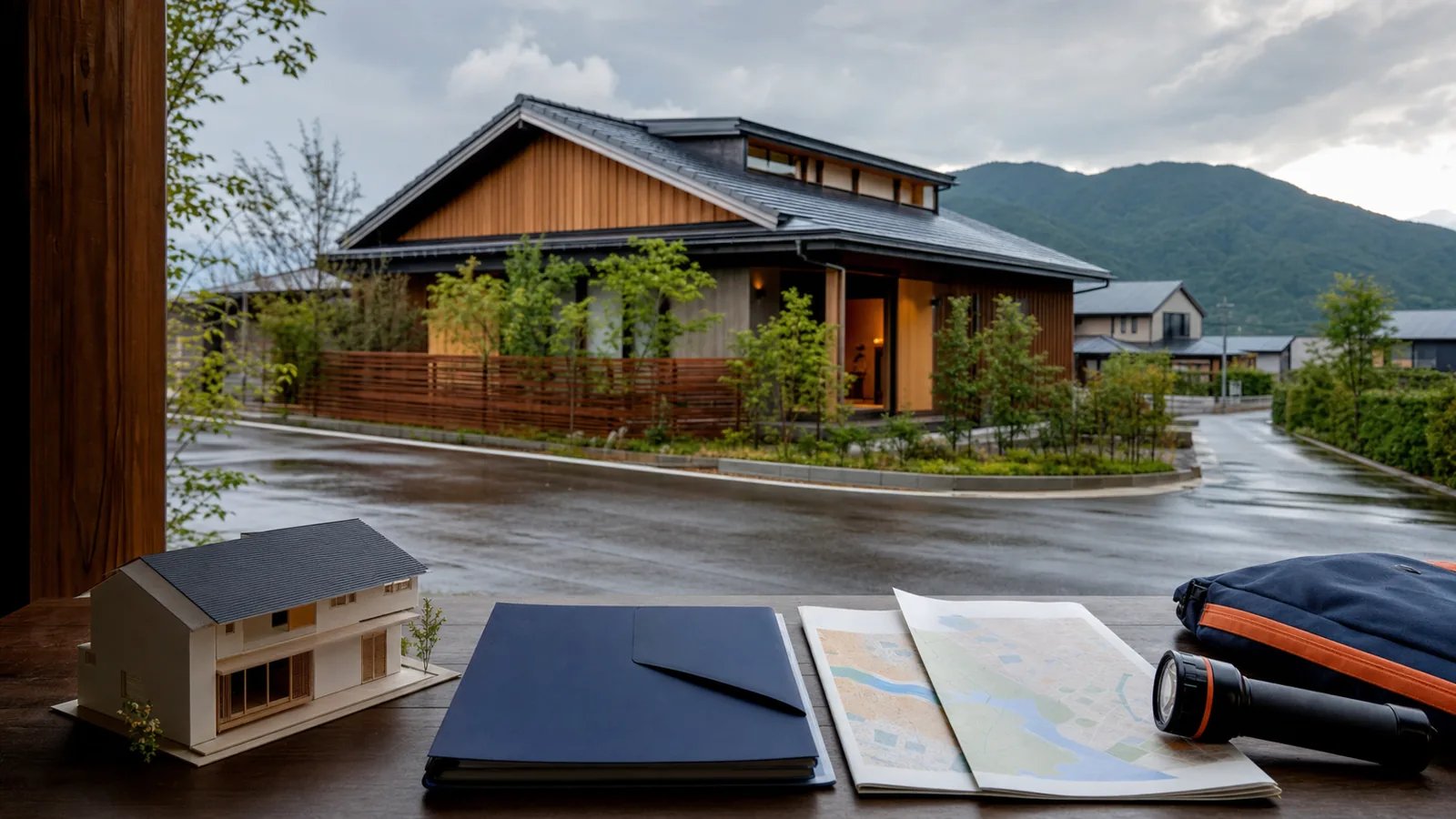
Earthquake insurance for property in Japan is attached to eligible fire insurance; it is not a stand-alone, full-rebuild policy. The statutory scheme covers residential buildings and household goods for earthquake, volcanic eruption, and resulting tsunami damage, subject to insured-amount limits and defined loss categories. Ordinary fire insurance generally does not cover fire caused by an earthquake.
The practical buyer task is to separate earthquake, fire, wind, flood, snow, water leakage, liability, and commercial-use risks, then obtain property-specific written quotations before settlement. For the broader transaction, see our foreign buyer's guide to Japanese property.
What Japan's earthquake insurance covers
The Ministry of Finance's official English outline says the scheme indemnifies residential buildings and household goods for fire, destruction, burial, or wash-away caused by earthquake or volcanic eruption, including tsunami following either event.
It is designed to help stabilize life after a disaster, not necessarily to reproduce the building exactly. The government reinsures part of the system because a major event can produce losses beyond ordinary private-insurance capacity.
It must be attached to fire insurance
You cannot buy the statutory residential earthquake policy by itself. It attaches to eligible fire insurance. If a fire policy is already in force without earthquake cover, the Ministry of Finance and the General Insurance Association of Japan (GIAJ) explain that earthquake cover can generally be added during the fire-policy term. See the GIAJ earthquake-insurance Q&A.
This distinction matters because fire caused by earthquake is not indemnified by ordinary fire insurance under the statutory framework. Do not infer coverage from the words “fire insurance.”
Buildings and contents are separate
The residential building and household goods are separate insured interests. A policy on the structure does not automatically insure its contents. The Ministry of Finance also lists exclusions from the earthquake scheme, including non-residential buildings and certain high-value or financial items.
If the property is mixed residential and commercial, vacant, under major renovation, rented, or intended for lodging, disclose that use and ask the insurer to state which portions and activities are eligible.
The insured amount is deliberately limited
Under the national scheme, the earthquake insured amount is set between 30% and 50% of the corresponding fire-insurance amount, capped at ¥50 million for the building and ¥10 million for household goods. These are statutory scheme limits stated in the Ministry of Finance outline, not a recommendation for your particular policy.
That structure creates a potential gap between:
- the building's purchase price;
- land value, which is not the insured building;
- the fire-policy valuation;
- the earthquake insured amount;
- actual demolition, temporary housing, repair, or rebuild cost;
- loan balance.
Ask the broker to show those figures side by side. Never assume an outstanding mortgage defines the claim amount.
Claims use loss categories, not a repair invoice alone
For current contracts, the statutory system assesses insured buildings or household goods into four categories:
| Loss category | Payment under the national scheme |
|---|---|
| Total loss | 100% of earthquake insured amount |
| Large half loss | 60% |
| Small half loss | 30% |
| Partial loss | 5% |
Payments remain subject to the applicable market-value and policy limits. The Ministry of Finance publishes detailed thresholds for structural damage, burned or washed-away floor area, inundation, and household-goods damage in its indemnification table.
This means a repair estimate and a statutory category are different concepts. Ask how the insurer evaluates the principal structural parts of the specific building and how you should document damage.
Fire, flood, wind and water need separate review
“Disaster insurance” is not one standardized all-risk bundle. GIAJ's housing insurance overview distinguishes fire insurance from earthquake insurance and warns that fire policies vary in scope.
GIAJ's fire-insurance coverage comparison shows that products can treat wind, hail, snow, flood, impact, plumbing leakage, theft, and other risks differently. Confirm each peril, deductible, limit, exclusion, and valuation basis in your proposed wording.
Use a coverage matrix:
| Scenario | Which section responds? | Limit/deductible | Key exclusion or condition |
|---|---|---|---|
| Ordinary house fire | |||
| Fire following earthquake | |||
| Earthquake structural damage | |||
| Tsunami after earthquake | |||
| River or surface-water flood | |||
| Typhoon wind | |||
| Heavy snow | |||
| Landslide | |||
| Burst pipe or leakage | |||
| Contents loss | |||
| Temporary accommodation | |||
| Debris removal/demolition | |||
| Third-party liability |
Require written answers. Similar product names can conceal different deductibles and extensions.
Premiums and earthquake discounts
The statutory earthquake premium reflects location and building structure. The Ministry of Finance lists four discount routes tied to evidence of seismic isolation, earthquake-resistance class, qualifying seismic diagnosis, or construction age. Its current table states discounts from 10% to 50%, depending on the route, and says they cannot be stacked.
Do not claim a discount from the listing's stated construction year alone. Ask what official document the insurer accepts—such as construction records, performance documents, or qualifying diagnosis evidence—and whether later alterations affect underwriting.
For an older home or akiya, an insurance conversation before purchase can expose missing records, construction uncertainty, vacancy restrictions, or required repairs. Pair it with the akiya renovation cost framework.
A foreign owner's insurance workflow
Before making an unconditional commitment
Give the insurer or licensed intermediary:
- exact address and building use;
- structure, floor area and year built;
- occupancy and vacancy pattern;
- renovation status and planned work;
- photographs and inspection findings if requested;
- rental, business, minpaku, or mixed-use plans;
- lender requirements;
- desired building and contents cover.
Ask whether policy documents, notices, claims support, and emergency calls are available in a language you understand. GIAJ publishes a foreign-language consultation and insurer contact page, but service availability differs by company and function.
Before handover
- Confirm effective date and payment.
- Check the named insured and insured property.
- Check whether building and contents are both intended.
- Confirm earthquake attachment rather than assuming it.
- Record declared occupancy and use accurately.
- Store policy numbers and claims contacts off-site.
- Photograph the building and contents.
- Keep registry, plans, receipts, inspection and retrofit documents.
After renovation or a change of use
Notify the insurer as required. Building area, structure, use, vacancy, rental operation, equipment, and insured value can change the risk. Ask for written confirmation that the updated policy reflects the completed work.
Insurance does not replace risk reduction
Use official municipal hazard maps, inspect evacuation routes, secure furniture and equipment, maintain fire detection, manage vegetation and drainage, and consider structural assessment and retrofit. Explore nearby shelters using the Nipponhomes earthquake evacuation map, then verify designation, route, and opening rules with the municipality.
For property selection, compare location and building alternatives through Nipponhomes' Japan guides and property explorer. The questions will not be identical for property in Sendai, homes in Naha, and houses around Hakone: earthquake, tsunami, typhoon, flood, landslide, volcanic, and access conditions have different local relevance. Insurance is one layer in a risk plan; it cannot make a poor site, unsafe structure, or inaccessible evacuation route disappear.
Keep a household continuity plan outside the policy file as well: emergency cash, medication, identification, contact details, and a way to receive official alerts. Insurance addresses financial loss after an insured event; it does not provide the supplies or decisions needed during the first hours of evacuation.
Questions to ask before choosing a policy
- Is the building eligible in its present occupancy and condition?
- Is earthquake cover attached, and at what percentage and amount?
- Are building and contents both included?
- Which fire, wind, flood, snow, water and liability perils apply?
- What are the deductibles, sublimits and major exclusions?
- Is valuation based on replacement cost or current value for each section?
- How are debris removal, temporary accommodation and code-related upgrades treated?
- What documentation qualifies for an earthquake premium discount?
- Must vacancy, renovation, rental or business use be notified?
- What languages are available for policy explanation and claims?
Sources
- Ministry of Finance — Outline of Japan's earthquake insurance system
- General Insurance Association of Japan — Housing insurance overview
- General Insurance Association of Japan — Adding earthquake cover to fire insurance
- General Insurance Association of Japan — Fire-insurance coverage
- General Insurance Association of Japan — Foreign-language consultation services
Important note
This article is general information, not insurance, legal, financial, structural, or disaster-planning advice. Policy wording, underwriting, premiums, eligibility, limits, and support vary. Obtain and understand current written terms from a licensed provider for the specific property and use.