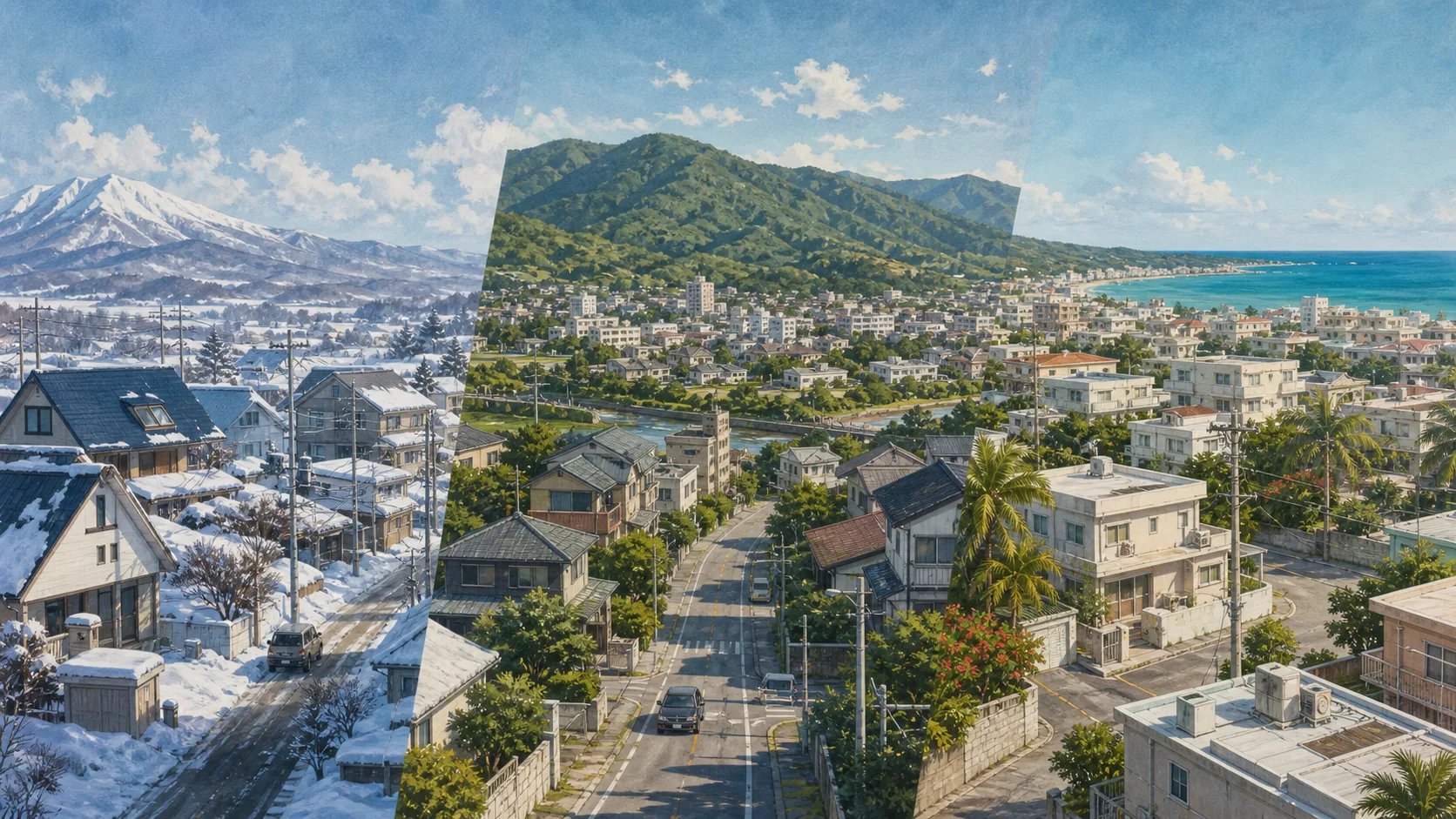
To buy property in Hokkaido, Okinawa or Tohoku responsibly, start with climate, access, maintenance, and exit demand rather than the postcard view. Hokkaido rewards buyers prepared for snow and heating; Okinawa requires salt, wind, humidity, and island-logistics planning; Tohoku offers several distinct city and rural markets but demands local hazard and winter due diligence.
This is a regional screening guide, not a claim that one prefecture is universally best. Read the foreign-buyer purchase process, then use the tests below to decide where an on-the-ground search is justified.
The three-region decision in one table
| Region | Strongest fit | Cost that buyers under-model | First rejection test |
|---|---|---|---|
| Hokkaido | Snow lifestyle, urban Sapporo base, managed second home | Heating, snow work, winter vacancy checks | Inadequate insulation, access, or frozen-pipe plan |
| Okinawa | Warm-climate living, long personal use, specific local ties | Salt corrosion, moisture, wind protection, island logistics | Unacceptable flood, storm-surge, tsunami, or access exposure |
| Tohoku | Regional-city life, family ties, patient value search | Local variation, winterization, thin rural exit markets | No recent comparable sales or realistic future buyer |
The climate contrast is measurable. JMA's 1991–2020 climatological normals report annual mean temperatures of 9.2°C for Sapporo, 12.8°C for Sendai, and 23.3°C for Naha (JMA climate normals). Those city observations do not describe every property, but they show why one generic maintenance budget cannot cover all three regions.
Hokkaido: buy for a snow-ready operating plan
Hokkaido is not one property market. A Sapporo condominium, Niseko-area resort home, Hakodate house, and remote inland akiya have different occupant demand and management needs. The common test is whether the building and owner are ready for winter.
Hokkaido's official English living guide describes the region's cold, snowy winter from December through March and warns about falling snow or ice from roofs (Hokkaido Government living guide). For a buyer, that translates into building-specific questions.
Hokkaido inspection checklist
- What are the insulation, glazing, airtightness, and heating systems?
- Where are pipes routed, and how is freezing prevented during vacancy?
- Who clears the drive, path, roof, and municipal-road interface?
- Where can snow be stored without blocking neighbors or access?
- Can a manager reach the property after heavy snowfall?
- What were the last two winters' fuel and electricity costs?
- Is parking usable year-round?
- Has condensation, ice damming, or roof leakage occurred?
For condominiums, ask how snow work and heating of common areas affect monthly fees. For detached homes, obtain written inspection and servicing plans rather than relying on a seller's description of “winterized.”
Where to start in Hokkaido
- Sapporo: strongest first screen for urban services, rail access, and a larger year-round population; begin with Sapporo homes.
- Hakodate or Asahikawa: use-led options where personal ties or daily needs support the choice.
- Resort areas: compare Niseko properties only after testing seasonal demand, management capacity, development rules, water and road access, and a non-heroic exit case.
- Rural towns: consumption or renovation projects first; do not assume the low price creates liquidity.
Browse Hokkaido properties, then compare transactions by municipality and property type through MLIT's official data.
Okinawa: the building envelope is part of the location
Okinawa can suit buyers who will spend meaningful time there and understand island life. A sea view does not cancel wind, driven rain, ultraviolet exposure, moisture, salt corrosion, or evacuation considerations. Concrete construction may be common, but concrete alone does not prove waterproofing, reinforcement condition, or good maintenance.
Okinawa inspection checklist
- Inspect roof and balcony waterproofing history.
- Check concrete for cracks, spalling, rust staining, and prior repairs.
- Inspect metal railings, outdoor equipment, fasteners, and air-conditioning units for corrosion.
- Ask how windows, shutters, doors, tanks, and exterior objects are secured.
- Look for indoor moisture, mold, ventilation, and dehumidification problems.
- Confirm drainage paths and whether surrounding roads flood.
- Price transport for materials, replacement equipment, and specialist labor.
- Verify an occupied-season and absent-season property-care plan.
Use the national Hazard Map Portal and the municipality's own maps for flood, landslide, tsunami, storm-surge, and evacuation information. A prefecture-wide label cannot substitute for elevation, construction, route, and address-level evidence.
Where to start in Okinawa
- Naha and the main urban area: Naha homes are a practical first screen when airport and everyday services matter.
- Main-island suburban municipalities: compare car dependency, congestion, schools, healthcare, and hazard routes.
- Outer islands: buy only after modeling flights or ferries, trades availability, materials, property checks, and emergency response.
Browse Okinawa properties. If short stays are part of the plan, confirm the exact lawful route before valuing nightly revenue. Japan's official portal distinguishes Inns and Hotels Act permission, Special Zone authorization, and Private Lodging Business Act notification; local and building limits can still apply (Japan Tourism Agency minpaku comparison).
Tohoku: six prefectures, not one bargain market
Tohoku consists of Aomori, Iwate, Miyagi, Akita, Yamagata, and Fukushima. Treating them as one market hides the buyer's most important variables: city scale, rail and airport access, snowfall, topography, industry, disaster exposure, and the depth of future demand.
Practical starting points
Sendai and Miyagi are the natural first screen for buyers who want the region's largest urban base. Compare station areas, suburban rail or car access, and address-level hazards. Start with Sendai properties.
Aomori, Akita, and Yamagata can suit buyers with strong snow-country preferences or family and work ties. Winter access, heating, snow storage, vacancy care, and future buyer depth should carry high weights. Browse Aomori, Akita, and Yamagata.
Iwate requires careful distance analysis because “near Morioka” and a remote coastal or inland municipality imply different services and management. Review Iwate properties.
Fukushima cannot be evaluated by a single prefecture-wide narrative. Confirm the specific municipality, current land-use and access facts, hazard information, and any applicable official restrictions or notices. Start with Fukushima listings and current government sources for the exact address.
Tohoku exit-liquidity test
Before offering on a low-priced house:
- Find recent transactions for the same property type, size, age, and municipality.
- Count active true comparables, not every home in the prefecture.
- Ask two local agents who the next buyer is likely to be.
- Estimate time to sell under a realistic price reduction.
- Check whether demolition, boundary, road, septic, well, or retaining-wall issues could narrow the buyer pool.
- Price the home as a long-term use asset if comparable evidence is too thin.
MLIT says its national transaction-price system has accumulated millions of records from transaction-party questionnaires and provides details such as area, building use and structure, build year, road, station, zoning, and coverage ratios (MLIT transaction-price system). The library also warns that prices are not adjusted for individual property circumstances (MLIT methodology).
Due diligence that applies in all three regions
Access and absence
Perform the trip from the airport or station with luggage and in the difficult season. Confirm the last public-transport connection, winter or storm disruption, parking, and emergency access. Then appoint someone who can inspect after severe weather.
Hazards and insurance
Check multiple hazards at the exact parcel, identify evacuation routes, and discuss cover with a licensed insurer. A map is a screening tool; an engineer, surveyor, municipality, and insurer answer different questions.
Building condition
Use an independent inspection matched to the construction and climate. Include roof, waterproofing, drainage, structure, services, moisture, pests, retaining walls, access, and unpermitted additions.
Intended use
Confirm zoning, condominium rules, local ordinances, lender and insurer conditions, and lodging permissions before underwriting rental income. Read our Japan property investment guide for foreigners if the purchase must generate income.
Remote ownership
Budget property management, tax administration, mail, utility payments, seasonal work, inspections, and emergency authority. Cheap homes can be expensive to leave unattended.
Which region should you shortlist?
Choose Hokkaido when snow, winter sport, or northern-city life is central to the goal and you can fund winter operations. Choose Okinawa when warm-weather use and local access justify the corrosion, moisture, wind, and logistics burden. Choose Tohoku when a specific city, family connection, or long-term regional plan matters more than a generic “cheap Japan” search.
Compare inventory across all Japan prefectures and Nipponhomes Explore. For very low-cost vacant homes, use the dedicated akiya search and underwrite renovation and resale separately.
Sources
- Japan Meteorological Agency: 1991–2020 climatological normals
- Hokkaido Government: English living guide for housing and winter
- GSI/MLIT: Hazard Map Portal
- MLIT: transaction-price information system
- MLIT Real Estate Information Library: data methodology
- Japan Tourism Agency: comparison of private-lodging systems
Important note
This article is general information, not legal, tax, engineering, hazard, insurance, investment, or valuation advice. Conditions vary by parcel and rules change. Verify the title, intended use, building condition, hazards, access, insurance, and current local requirements with qualified professionals.