Questions fréquentes
Réponses aux questions courantes sur l’achat immobilier au Japon
Eligibility & ownership
Are there any strings attached to buying a home in Japan as a foreigner?
Nope. Foreigners have the exact same ownership rights as Japanese citizens. There are no extra fees, no visa requirements, no renovation mandates, and no minimum stay rules.
You get the same freehold title a Japanese national gets, registered publicly at the Legal Affairs Bureau (法務局), and it is perpetual — not a long lease. There is no foreign-ownership category, no nominee requirement, and no government approval step before you bid. The catch is not legal, it is practical: contracts are binding in Japanese, most agents do not work in English, and financing as a non-resident is difficult.
For the full walkthrough, read our guide to buying property in Japan as a foreigner.
Is the house actually mine?
Yes, 100%. The title is in your name, and you'll be the legal owner. No one else has a claim on it.
Ownership is recorded on a public register at the Legal Affairs Bureau, the title is yours in perpetuity (not a lease), and it passes to your heirs. A judicial scrivener (司法書士) files the transfer of title on completion day — that filing is what actually makes the property yours, which is why the scrivener is not optional. You can also sell to anyone, including back to a Japanese buyer, with no restriction.
See how title registration and the closing process work in our buyer guide.
Does buying a home give me a path to citizenship or residency?
Unfortunately, no. Buying property in Japan does not grant you residency, a visa, or citizenship.
Japan has no residence-by-investment or golden-visa programme tied to real estate. Owning a house does not extend a tourist stay by a single day. A long-term visa, if you qualify for one, is granted on its own merits — work, spouse, or the highly-skilled-professional points system — and owning property can at most be a supporting detail in a future application, never the basis for one.
We separate the property question from the visa question in our guide to buying property in Japan and residency.
Costs, taxes & insurance
How much are the taxes? They've gotta get you somewhere, right?
Japan's property taxes are shockingly low. There are two main annual taxes:
Fixed Asset Tax (Kotei Shisanzei) - kind of like your federal property tax.
City Planning Tax (Toshi Keikakuzei) - this one goes to your local municipality.
Together, they usually total around 1.7% of the assessed value of the property. Cheap homes = Cheap taxes. For example, our own annual tax bill is around $600 USD/year. Yea you read that right $600 USD
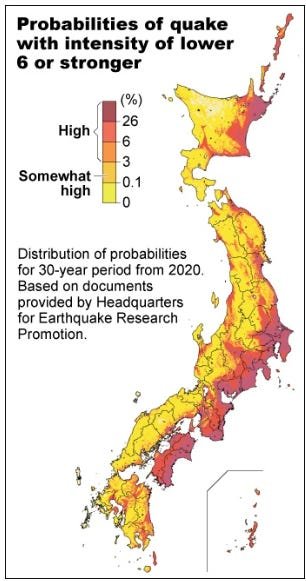
What about earthquakes and natural disasters?
Japan introduced stricter earthquake-resistant building codes in 1981 and 2000. Insurance is excellent and affordable, with Fire and Earthquake Insurance typically costing around $242 USD per year.
The codes are the thing to know as a buyer: a building from before 1981 (pre-新耐震) is held to a weaker seismic standard, and before 2000 to a weaker high-rise standard. That is why the year built drives both financing and insurance pricing on older stock, and why pre-1981 akiya look cheap. Earthquake insurance is optional and bundled with fire insurance through the government-backed Japan Earthquake Reinsurance pool, capped at 30–50% of the fire-insured amount.
We go deeper on cover, pricing, and what the seismic codes mean in our earthquake and disaster insurance guide.
Owning & using your property
Can I Airbnb my home?
Yes, but regulations are strict and vary dramatically by location. Japan's minpaku rules are cumulative - national, prefecture, and city regulations all stack on top of each other.
The national baseline:
- Maximum 180 days per year (without a Ryokan license)
- Must register your property and meet fire safety standards
- Requires a local property manager if you don't live nearby
But cities add their own rules on top:
- Osaka - Banned entirely in residential zones (unless your property faces a road 4m+ wide)
- Kyoto - Only ~60 days/year in residential zones (Jan 15 - Mar 16)
- Sapporo - Weekends and holidays only in residential zones
Owner-occupied properties often get exemptions from these restrictions. Use our Zoning / Airbnb eligibility layer (included in the Pro plan) to check short-term rental rules for any specific property before you buy.
How do I pay property taxes and set up utilities if I don't live in Japan?
You'll need a tax representative (納税管理人, nozei kanrinin). They can handle tax payments, utility setup, and bill forwarding or payment handling.
Japanese authorities need a domestic point of contact for property-tax notices when the owner lives abroad, so appointing a tax representative is effectively mandatory for a non-resident owner. Set this up around settlement, not at your first filing deadline — the same window is when the FEFTA post-purchase report falls due.
- Tax payments
- Utility setup
- Bill forwarding or payment handling
The reporting and tax-representative steps are covered in our buyer guide.
Older homes & akiya
What's the quality of these old homes?
Quality varies. Cultural differences include:
More important than taste is era. Most vacant akiya on the market were built before 1981, when Japan’s current seismic code took effect. A pre-code building frequently needs structural retrofitting before a lender or insurer will look at it sensibly, and almost all need electrical, plumbing, roofing, and insulation work before they meet modern expectations of comfort. The realistic assumption is that renovation costs as much as the purchase price or more.
- Lack of insulation
- Compact layouts
- Often only one bathroom
- Different kitchen and bathroom setups
If that trade-off is what you are after, browse akiya for sale across Japan — each listing is translated and the inventory refreshes daily.