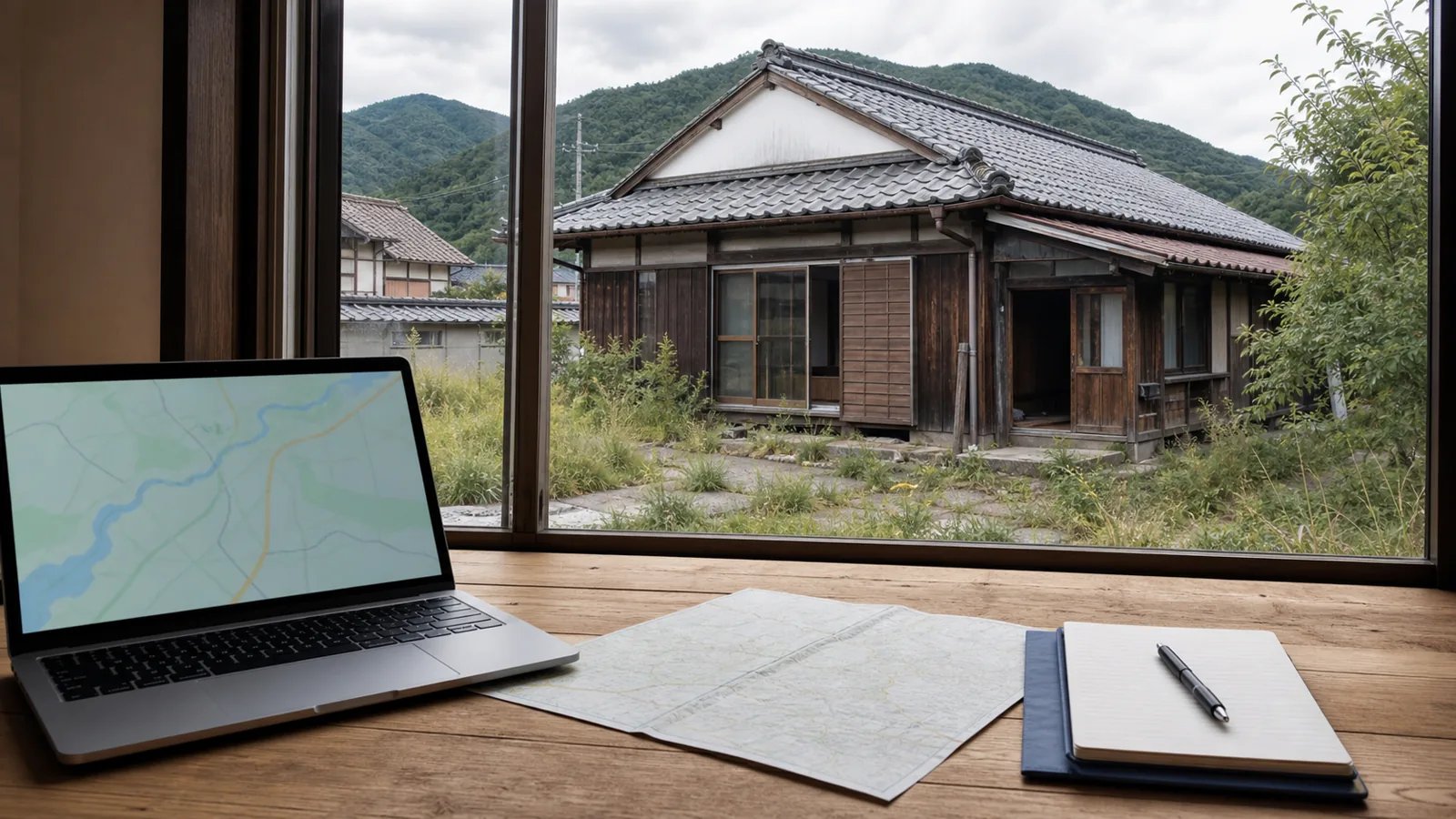
An akiya bank in Japan is a local-government listing service for vacant homes, not a bank that lends money. The search phrase “akiya bank Japan English” usually leads to national aggregators, but you should also check the municipality's own site because local listings, registration rules, incentives, and contacts may not all appear in one place. Most people arrive looking for akiya bank houses for sale at very low prices, and some listings really are cheap. An English interface can help you discover a property, but it does not replace Japanese-language due diligence or a licensed professional.
This guide explains the practical search process. For the wider purchase procedure, taxes, and legal checks, read our guide to buying property in Japan as a foreigner. You can also browse Nipponhomes' akiya listings and guides.
What an akiya bank actually does
Municipalities created akiya banks as one tool for bringing unused homes back into use. Owners ask to register properties; prospective buyers or tenants search them and contact the program or its designated intermediary. The municipality is usually a matchmaker, not the seller, surveyor, guarantor, or mortgage provider.
Japan's Ministry of Land, Infrastructure, Transport and Tourism (MLIT) supported two nationwide portals so users could search participating municipalities across local boundaries. The national system has been in full operation since April 2018 and is operated by LIFULL and At Home, according to MLIT's national vacant-house and land bank information page.
That structure explains why there is no single complete database:
| Layer | What it is good for | What can be missing |
|---|---|---|
| National portals | Broad, cross-prefecture discovery | Municipalities that do not participate; some local listings |
| Municipal akiya bank | Local eligibility, contacts, incentives, newer details | English translation; consistent filters |
| Ordinary property portals and agents | Wider market inventory and transaction support | Off-market or municipality-led opportunities |
| Local networks | Homes not yet formally marketed | Standardized documentation and buyer protection |
MLIT's consumer Q&A notes that akiya banks are voluntarily established by individual municipalities and that a property on a local bank may not appear on a national portal. Treat the MLIT consumer Q&A as a useful explanation of the system, then verify today's process with the town or city.
Why akiya-bank houses are cheap, and what the price leaves out
Japan's supply of empty homes is large. The 2023 Housing and Land Survey by the Ministry of Internal Affairs and Communications (MIC) counted about 9.0 million vacant dwellings, or 13.8% of the housing stock. That figure includes homes held for rent or sale and second homes, so it is not a count of houses waiting on akiya banks, but it explains why many rural towns have more houses than buyers. See MIC's 2023 survey preliminary results (Japanese).
On municipal programs, it is common to find houses for sale through akiya banks at asking prices under ¥5 million, and in depopulating areas some are offered for a token amount. Low prices usually reflect weak local demand, the building's age and condition, or both. They are not a discount the municipality funds.
Ordinary real-estate agents often pass on these listings. In Japan, brokerage fees are capped as a percentage of the sale price, so a very cheap house pays an agent little for the same viewings, investigation, and paperwork as an expensive one. In 2024 MLIT raised the special fee ceiling for low-priced vacant homes (¥8 million or less) to ¥300,000 plus consumption tax, as part of a program to get more brokers handling vacant homes. A broker can only charge above the standard cap if it explains the fee and agrees it with the client before signing the brokerage contract, so ask about fees at the start. See MLIT's June 2024 announcement (Japanese).
A short reality check before you shortlist:
- Condition: many listed homes have sat empty for years. Expect roof, moisture, plumbing, insulation, and possibly structural work, plus clearing out belongings left behind.
- Remoteness: the nearest supermarket, clinic, or station may be a drive away. Bus and rail service can be thin, and some areas get heavy snow.
- Resale: a house that was hard to sell once may be hard to sell again. Weak demand is often the reason the price is low.
None of this rules a house out. It means the advertised price is the start of the budget.
How to find akiya-bank listings in English
1. Search the national portals
Begin at the portal links maintained on MLIT's national akiya-bank page. Browser translation can make Japanese filters usable, but keep the original text available. Machine translation can blur important distinctions such as sale versus lease, residential land versus farmland, or repair history versus recommended repairs.
Search more broadly than your ideal town. Sparse rural inventories change irregularly, and a neighboring municipality may offer similar rail access, climate, or services. Nipponhomes' Japan area pages and property explorer can help you compare the ordinary market around an akiya listing. For a concrete Hokkaido comparison, review the wider inventory of homes for sale in Otaru and property around Furano rather than judging an akiya-bank lead in isolation.
2. Open the municipality's own website
Search the municipality name plus 空き家バンク and look for an official .lg.jp or city website. Confirm:
- whether the listing is still active;
- whether users must register before viewing or negotiating;
- whether the municipality introduces a broker or asks the parties to deal directly;
- whether the property can be bought, leased, or either;
- whether residency, age, household, or business-use conditions apply;
- whether farmland, forest, or unregistered outbuildings are included;
- whether grants require akiya-bank registration.
Do not assume another town's process applies. MLIT describes the national portals as aggregating information held by municipalities; the local program still controls its own participation and procedures.
3. Contact the local office with a precise inquiry
Include the listing number, your intended use, expected move date, language needs, and whether you can visit in person. Ask for the current property sheet and the name of any designated real-estate intermediary. A short bilingual inquiry usually works better than a long generic request.
Useful questions include:
- Is the property still available, and has an application already been accepted?
- Is user registration required before a viewing?
- Who represents the seller and prepares the contract?
- Are the land and every structure registered consistently?
- Are there occupancy, resale, renovation, or business-use conditions?
- Is any attached land classified as agricultural land?
- Which hazard maps cover the parcel?
- Are subsidy applications required before contract or construction?
If farmland accompanies the house, pause before assuming it transfers like residential land. MLIT's revised guide to vacant homes with farmland points buyers to the separate legal and administrative issues involved.
What registration does—and does not—mean
Registration is an intake process, not a quality certification. An akiya-bank property may be habitable, partly deteriorated, filled with possessions, difficult to insure, or expensive to connect to modern services. A municipality accepting a listing does not mean it has inspected the structure for you.
Use the listing as a lead, then run normal purchase due diligence. MLIT explains that a building-condition inspection is a primarily visual and measurement-based check for deterioration such as cracking or water intrusion; it does not establish that no defect exists. See MLIT's consumer guidance on building-condition inspections.
At minimum, verify:
| Check | Why it matters |
|---|---|
| Land and building registry | Confirms registered ownership, mortgages, parcel and building records |
| Boundary and access | Private roads, unclear boundaries, or poor legal access can obstruct finance and rebuilding |
| Planning and building status | Existing use does not automatically prove lawful expansion or future rebuild rights |
| Structure, roof, moisture and pests | Determines the realistic repair scope |
| Water, sewer/septic, electricity and gas | Rural service conditions can reshape the budget |
| Hazard maps and evacuation access | Flood, landslide, tsunami, snow and seismic risks are location-specific |
| Insurance quotation | Coverage and insurability should be checked before commitment |
| Contents and demolition responsibility | “As is” can include belongings, sheds, trees and disposal work |
For earthquake and evacuation context, compare official local hazard maps with the Nipponhomes earthquake evacuation map.
The safest order of operations
The strongest buyer workflow is:
- Discover: save the listing page, municipality page, parcel location, photographs, and listing date.
- Pre-screen: compare transport, services, hazards, renovation feasibility, and ordinary market alternatives.
- Register locally: complete the municipality's user process if required.
- Visit: inspect the house and neighborhood in different weather if feasible.
- Build a professional team: use an appropriate licensed broker, judicial scrivener, architect or building professional, tax adviser, and translator as the facts require.
- Investigate before committing: obtain registry records, disclosures, an inspection, repair scoping, insurance quotes, and written confirmation of special conditions.
- Price the whole project: include acquisition, transaction costs, immediate safety work, utilities, ongoing tax, maintenance, and contingency—not just the advertised price.
- Contract with clear conditions: record included land, buildings and contents; repair responsibility; handover; and any financing or legal conditions.
The purchase price can be the smallest number in an akiya project. Our akiya renovation cost guide shows how to build a property-specific budget without relying on a misleading nationwide average.
Can a foreign buyer use an akiya bank?
Nationality and Japanese residency are different questions from whether a local program will register a user or attach conditions to an incentive. A foreign buyer should not infer eligibility from an English listing page. Ask the municipality in writing and distinguish:
- eligibility to search or register;
- legal ability to purchase the specific property;
- eligibility for financing;
- eligibility for a local grant;
- any obligation to reside, relocate, or retain the home.
Buying a house does not itself grant a visa or residence status. Plan immigration and property ownership as separate workstreams. The broad transaction path is covered in our foreign-buyer guide.
Conditions some municipalities attach
Akiya banks exist to bring residents and activity back to a town, so some municipalities attach conditions to listings, to user registration, or to the grants that come with them. Examples you may see include:
- living in the house as your main residence, sometimes for a minimum number of years;
- moving your registered address (jūminhyō) to the municipality;
- joining the neighborhood association and taking part in community work such as cleanups or snow clearing;
- limits on using the house as a holiday home, rental, or business;
- repaying a grant if you sell or move out early.
Requirements differ from town to town and between listings. Get them in writing, and check whether they apply to the purchase itself or only to a subsidy you could decline. A minimum-residence condition matters a lot if you cannot yet live in Japan full time.
Red flags in an akiya-bank search
Slow down if:
- the exact parcel cannot be confirmed before payment;
- the seller, registered owner, or heirs do not align;
- an intermediary discourages an independent inspection;
- the building has undocumented additions;
- access relies on an unclear private-road arrangement;
- attached farmland is treated as an ordinary garden without verification;
- a grant is presented as guaranteed;
- the quote excludes disposal, structural work, design, permits, tax, or utility renewal;
- you are pressed to sign remotely without a complete translated explanation.
An akiya bank can be an excellent discovery channel. Its real value is local access and context—not exemption from the checks that protect any buyer.
Related reading
- How to navigate municipal akiya bank websites, even when you don't speak Japanese
- The best akiya bank regions for foreign buyers
- Renovation budgets and reality checks: what ¥2 million in repairs actually buys
- The legal side: akiya contracts, conditions, and gotchas
- Akiya renovation subsidies in Japan
Sources
- MIC — 2023 Housing and Land Survey, preliminary housing counts (Japanese)
- MLIT — Vacant-home program for the real-estate industry, including the brokerage-fee revision (June 2024, Japanese)
- MLIT — Vacant House and Land Bank comprehensive information
- MLIT — National vacant-house bank consumer Q&A
- MLIT — Guide to vacant homes with farmland
- MLIT — Building-condition inspection guidance for existing-home transactions
Important note
This article is general information, not legal, tax, immigration, insurance, structural, or investment advice. Akiya-bank rules and listing status are municipality-specific and can change without notice. Confirm the current requirements and the specific property's facts with the relevant public office and qualified professionals before paying, signing, or starting work.