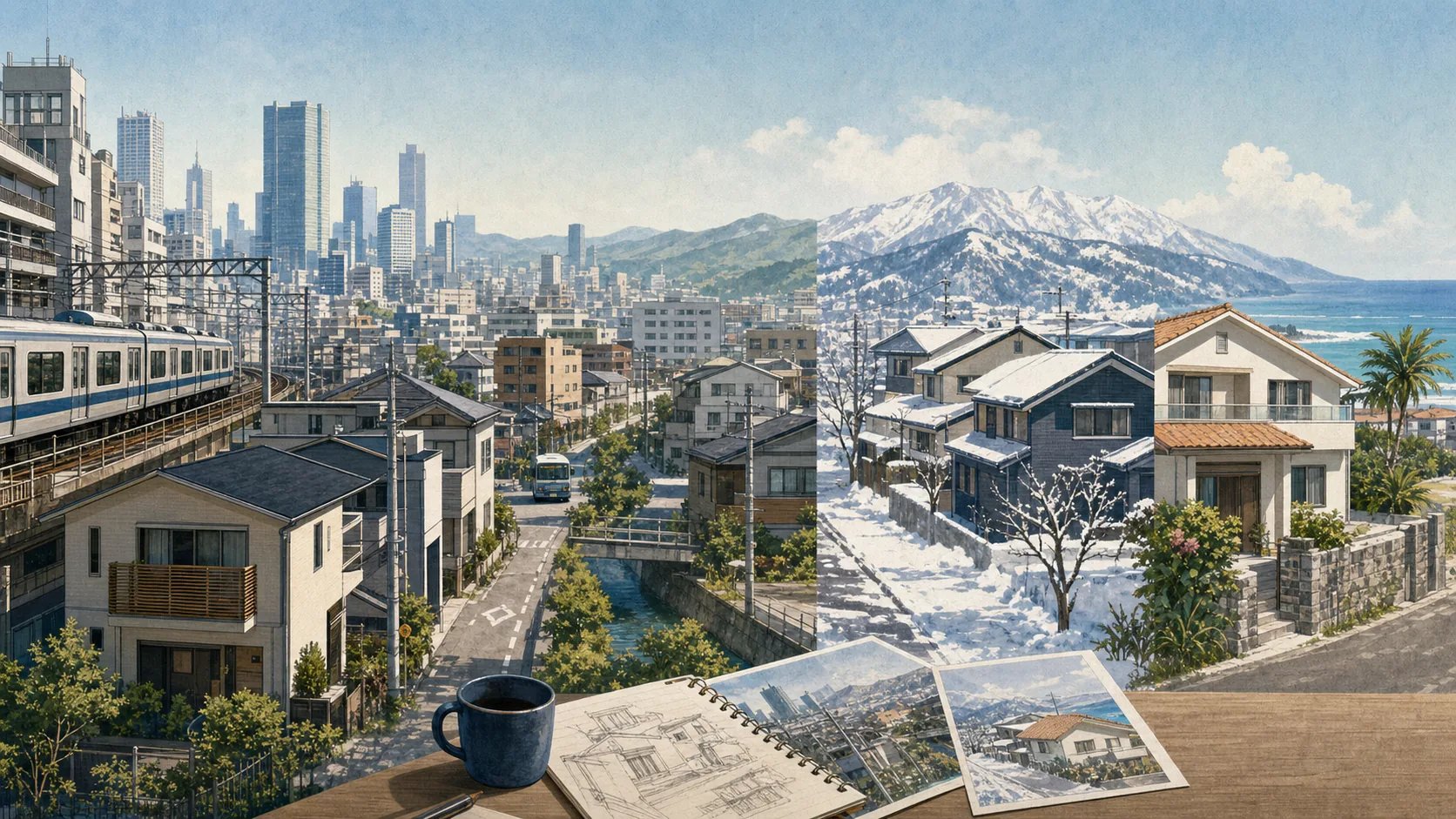
The best cities to buy property in Japan depend on what the home must do for you. Tokyo is the strongest default for resale depth and urban convenience; Osaka often suits buyers who want a major-city base with a different price profile; Fukuoka offers compact-city convenience; Sapporo fits snow-country and lifestyle buyers; and regional cities can work for owner-occupiers who accept thinner resale markets. There is no honest universal winner.
This guide ranks starting points, not guaranteed investments. First read our complete foreign-buyer guide, then use the framework below to turn a broad Japan search into a defensible shortlist.
How this ranking works
The order uses five criteria. Change their weights and the order should change too.
| Criterion | What to measure | Why it matters |
|---|---|---|
| Exit liquidity | Recent comparable sales, listing depth, days on market | A cheap purchase is not useful if resale is difficult |
| Everyday access | Rail, airport, hospitals, shops, schools | Access affects both personal use and tenant demand |
| Total ownership burden | Purchase price, taxes, management, repairs, climate costs | The headline price is only one cash-flow line |
| Property-use fit | Primary home, second home, long-term rental, renovation | A city can suit one strategy and fail another |
| Physical and regulatory risk | Flood, landslide, tsunami, seismic exposure, local rules | Risk varies block by block, not just by prefecture |
For price evidence, compare like-for-like transactions in MLIT's Real Estate Information Library. The underlying information is based on transaction-party questionnaires, published quarterly, rounded, and not adjusted for each property's individual condition, so it is a starting point rather than an appraisal (MLIT methodology). Check hazards separately on the national GSI/MLIT Hazard Map Portal.
Ranked starting points by common buyer objective
1. Tokyo: best default for liquidity and car-free access
Tokyo is the most defensible first screen for a buyer prioritizing transport, a broad pool of future occupants, and abundant comparable listings. But “Tokyo” is not one market. A small station-adjacent condominium in a central ward and a detached house at the metropolitan edge have different buyers, maintenance profiles, and exit paths.
Choose Tokyo when:
- you value rail access and do not want to depend on a car;
- resale optionality matters more than maximum floor area;
- you can tolerate a higher entry budget for a location with deeper demand; or
- you will use the property frequently enough to justify convenience.
Do not buy merely because the address is central. Review the building's reserve fund, long-term repair plan, management fees, seismic history, and actual unit rules. Start with Tokyo properties, then contrast Shinjuku homes near major rail hubs, Shibuya listings, and Minato properties before comparing asking prices with recent transactions near the same station.
2. Osaka: best major-city alternative
Osaka is a strong alternative for buyers who want a large urban economy, extensive rail service, and a different entry-cost profile from central Tokyo. It can also be a practical base for Kansai travel. The trade-off is that ward, station, building age, and walking distance still dominate the city label.
Choose Osaka when:
- your life or business is centered in Kansai;
- you want big-city services without treating Tokyo as the automatic answer;
- you can inspect condominium governance and local rental demand; and
- you have compared realistic monthly living costs, not stereotypes.
Our Tokyo versus Osaka cost-of-living guide explains how to build that comparison. Browse homes in Osaka City only after setting a station-access and building-age range.
3. Fukuoka: best compact-city shortlist
Fukuoka deserves a shortlist for buyers who value an airport close to the urban core, mild winters, and a relatively compact daily geography. It is not automatically “better value”: popular central areas can price differently from peripheral municipalities, and coastal or low-lying parcels require address-level hazard checks.
Choose Fukuoka when:
- frequent domestic or international flights matter;
- you prefer a smaller urban footprint than Tokyo or Osaka;
- your work and household needs fit the local economy; and
- you can confirm resale evidence for the specific station area.
Review Fukuoka City property options and compare several neighborhoods rather than selecting on prefecture-wide averages.
4. Sapporo: best snow-city lifestyle candidate
Sapporo offers substantial urban services with direct access to Hokkaido's outdoor lifestyle. Its decisive variable is winter. Hokkaido's official foreign-resident guide describes the region's cold, snowy winters and roof-snow hazards (Hokkaido Government living guide). Heating, insulation, frozen-pipe prevention, snow storage, road access, and roof design belong in the acquisition model.
Choose Sapporo when:
- winter is a feature, not an inconvenience;
- the building's envelope and heating system have been inspected;
- someone can manage the home during absences; and
- you understand seasonal access and operating costs.
Compare Sapporo homes with the very different Niseko market, then read our Hokkaido, Okinawa, and Tohoku regional guide.
5. Yokohama, Kobe, and Kyoto: best when regional identity matters
These cities can suit buyers who want access to a major metro while preferring a distinct local setting. They should not be grouped financially: Yokohama commutes into Tokyo, Kobe belongs to the wider Kansai system, and Kyoto carries tourism pressure and strong neighborhood variation.
Shortlist them only when your use case is specific:
- Yokohama or Kamakura: Tokyo-region access or a coastal Kanagawa lifestyle without insisting on a Tokyo address; compare the specific trade-offs visible in Kamakura listings.
- Kobe: Kansai access with a port-city and hillside geography; screen Kobe properties by rail access and topography.
- Kyoto: a personal or operational reason to be in Kyoto, with careful local-rule and street-level due diligence; review Kyoto City homes rather than prefecture-wide averages.
Never use a citywide median to price a particular house.
6. Sendai and other regional capitals: best for use-led buyers
Sendai, Hiroshima, Nagoya, and other regional centers may offer the best balance for a buyer with family, work, university, or lifestyle ties. Their advantage is not simply “cheapness.” It is the ability to choose a location you will actually use while retaining city services.
Regional purchases need a stricter exit test: count recent comparable transactions, identify likely future buyers, and ask how long similar homes have remained listed. If the answer is unclear, price the property as a consumption asset rather than assuming appreciation.
Explore Sendai homes, Hiroshima, and Aichi as separate markets.
A practical scorecard for your own ranking
Score each candidate from 1 to 5, then multiply by your chosen weight.
| Factor | Suggested weight: primary home | Suggested weight: investment |
|---|---|---|
| Personal access and daily fit | 30% | 10% |
| Resale and rental evidence | 20% | 35% |
| All-in operating cost | 20% | 25% |
| Building and hazard condition | 20% | 20% |
| Management simplicity | 10% | 10% |
Reject a property even with a high total score if it fails a non-negotiable: unsafe access, unclear title, prohibited intended use, inadequate reserves, or no credible management plan.
Research checklist before choosing a city
- Define how many weeks or months you will occupy the home.
- Set an all-in budget that includes closing, taxes, insurance, repairs, and currency contingency.
- Search actual transactions by property type, station, age, and size.
- Check flood, landslide, tsunami, and evacuation information at the address.
- Visit in the least convenient season, not only in good weather.
- Interview two local agents about likely future buyers and time to resell.
- Verify management rules before assuming rental or short-stay use.
- Compare at least three cities in Nipponhomes Explore, then inspect the relevant prefecture pages.
The right answer is a shortlist, not a winner
For most overseas buyers, the sensible first shortlist is Tokyo or Osaka for urban liquidity, Fukuoka for compact-city living, Sapporo for an intentional snow lifestyle, and one regional city tied to a real personal need. Rank neighborhoods and buildings only after that.
If a low-cost vacant home is the objective, city rankings are the wrong tool. Use the Nipponhomes akiya search and evaluate renovation, access, services, and resale independently.
Sources
- MLIT: Land prices and official real-estate information
- MLIT Real Estate Information Library: transaction-data methodology
- GSI/MLIT: Hazard Map Portal
- Hokkaido Government: English living guide
Important note
This article is general information, not investment, legal, tax, engineering, or valuation advice. Rankings are a decision framework, not a forecast. Verify current rules, hazards, property condition, title, and comparable transactions with qualified professionals before buying.